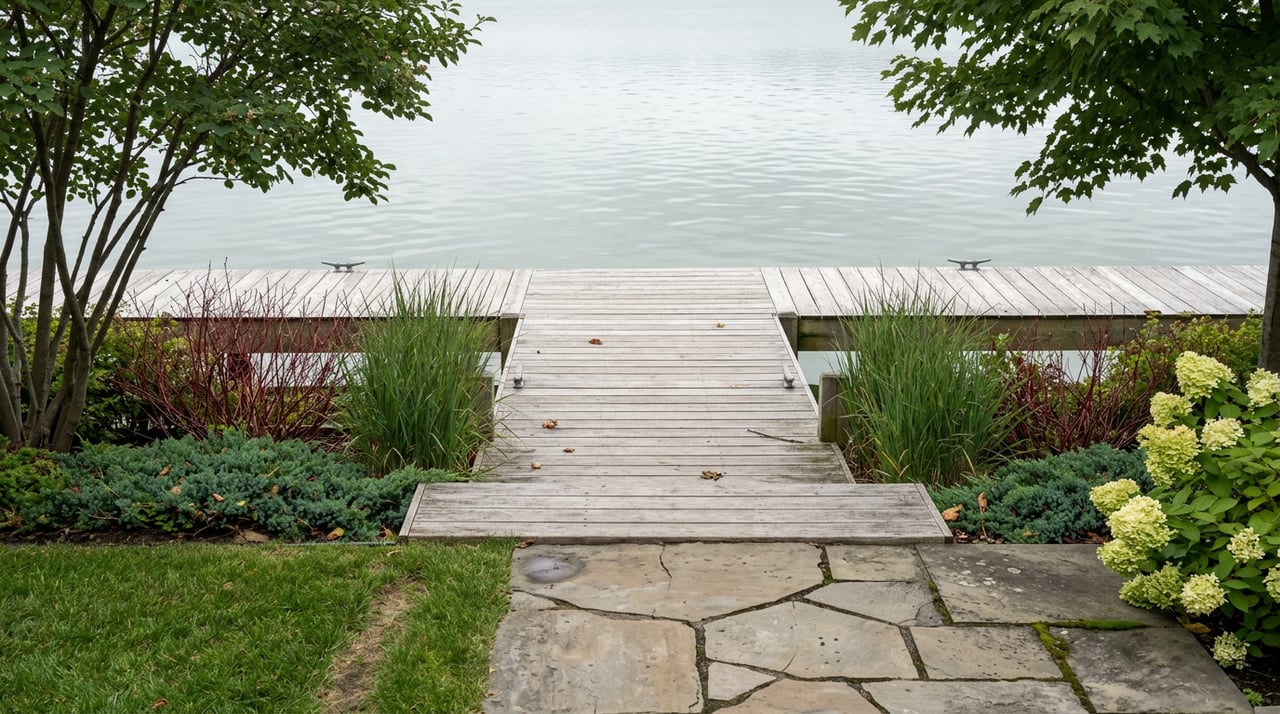
In February 2025, Innisfil council voted nine to zero to deny a boathouse. Every member on the record, no dissent. The applicant at 970 Shoreview Drive wanted to build a nearly 5,000-square-foot structure on piers over Lake Simcoe, and Deputy Mayor Kenneth Fowler called it "a flex of epic proportions." Councillor Linda Zanella pointed out it was more than three times the size of the house she lived in.
Thirteen months later, in March 2026, council approved a boathouse and dock combination at 3992 Guest Road in the Big Bay Point area that exceeded the town's own lot coverage limit by more than 100 square meters, a limit written into the 2025 update of the very bylaw council was applying.
Same council. Same bylaw. Opposite outcomes on projects that both broke the numeric standard. If you are buying or selling waterfront in Innisfil, that gap is the thing worth understanding before you write an offer or sign a listing agreement, because it tells you what actually gets approved on this shoreline, and it is not what the bylaw text says.
What "Our Shore" Actually Merges
Every residential property in Innisfil with frontage on Lake Simcoe falls under a Shoreline Permit system that combines five separate approvals into one application: zoning, minor variance, site plan, site alteration, and tree or grading review. The town calls it a one-window approach, and for most shoreline work, a new retaining wall, a septic upgrade, an addition that stays within setback, it genuinely is. Staff can approve straightforward applications without a public meeting.
The current version, Community Planning Permit By-law 058-25, was passed by council on June 25, 2025, replacing the older Comprehensive Zoning By-law 080-13 and the original 2017-era Community Planning Permit By-law 062-17 for the Shoreline and Alcona areas. Council amended it again through a housekeeping update presented at a March 18, 2026 public meeting, adjusting variation thresholds and lot coverage standards specifically within the Shoreline Residential precinct.
The One Rule That Never Changed
Buried inside the classification system is a carve-out that has survived every rewrite since the original "Our Shore" bylaw first cleared council in May 2017: no matter how small the project or how cleanly it meets every numeric standard, a boathouse application still lands on a council agenda for a public vote. Planner Nick Skerratt described the framework at the time as protecting roughly 1,200 existing buildings and structures already lining the shoreline, a legacy layer of docks and boathouses built before anyone regulated them formally.
That single carve-out is why two waterfront neighbors with comparable ambitions can end up in front of nine elected officials arguing about square footage, and why the numbers on the page turn out to be the opening bid, not the verdict.
Why the Math Didn't Decide It
Here is where the two 2025-2026 cases actually diverge, and it has nothing to do with compliance.
| 970 Shoreview Drive (Feb 2025) | 3992 Guest Road (Mar 2026) | |
|---|---|---|
| Ask | Six variances, including raising the max boathouse length from 10m to 14.38m | A 142 sq m boathouse plus a 99 sq m dock, totaling 266.2 sq m of accessory coverage, more than 100 sq m over the 2025 bylaw limit |
| Staff position | Recommended approval | Recommended approval |
| Council vote | Denied, 9-0 | Approved |
| Argument that carried the day | A precedent comparison to a prior approval (1610 Ladywood Way), which council rejected as justification | Proportionality to the lot's own frontage, screened by vegetation and slope, plus a letter of support from the neighbor to the west |
Staff argued the Guest Road structure would not visually dominate the shoreline given the property's water frontage, vegetation buffer, and slope, and pointed to the existing pattern of waterfront development in the Big Bay Point area. Council, including a hesitant Deputy Mayor Fowler, deferred to that framing even while raw square footage blew past the bylaw's own cap by more than 100 square meters.
Shoreview Drive had none of that context working for it. Council read the ask as scale for its own sake rather than scale relative to the lot, and the precedent argument staff offered actually backfired.
"It just seems that some waterfront properties think that they should be able to build whatever they want."
That was Councillor Robert Saunders, explaining the Shoreview denial. It is a fair description of the standard council is actually applying: not "does this meet the bylaw" but "does this look proportionate on this specific piece of shoreline, and does the neighborhood agree." A project that clears every number on the page can still fail that second test. A project that clears neither can pass it if the lot and the neighbors make the case.
What's Changing Through 2026
The Shoreline and Alcona version of the CPPS is not the end state. Innisfil has been working since a 2023 background study toward extending the same permit system town-wide, replacing Zoning By-law 080-13 everywhere rather than just the shoreline and Alcona. The town held a public open house on June 2, 2026 and a formal public meeting on June 10, 2026 to gather feedback on the draft, with Planning Project Manager Keirsten Morris listed as the contact for anyone tracking the file.
That matters for a shoreline buyer today for two reasons. First, the standards you are evaluating against right now are the March 2026 update, not the original 2017 numbers, and they can move again. Second, if you plan to eventually build on a parcel adjacent to the current Shoreline precinct, the process governing that land may be rewritten before you get there.
When the town passed the 2025 CPPS bylaw itself, the notice of passage gave anyone affected until 4:30 p.m. on July 30, 2025, roughly three weeks from the notice date, to file an appeal with the Ontario Land Tribunal, at a fee of $1,100. Individual permit decisions carry their own notice and appeal path through the same tribunal. A neighbor unhappy with an approval, or an applicant unhappy with a denial, has a real and time-boxed way to contest it, which is worth knowing if you are closing on a property with a pending or recently decided permit.
What This Means Before You List or Waive Conditions
If you own or are buying a structure on the water, boathouse, dock, retaining wall, the question that matters is not whether it meets today's standard. It is whether it was ever permitted at all. A structure built before the town's shoreline framework existed, or built without going through it, can be legal non-conforming, meaning it can stay but cannot necessarily be rebuilt the same way or expanded without going through the same council process described above.
Before listing a waterfront property, or before waiving conditions on one:
- Confirm whether existing docks, boathouses, or shoreline structures have a permit on file, not just an assumption they were "always there."
- Understand which class of permit any planned work falls under, since the boathouse carve-out applies regardless of how minor the project looks on paper.
- Ask whether Lake Simcoe Region Conservation Authority sign-off was required for any past shoreline work, since LSRCA review runs alongside the town's process for vegetation removal, retaining walls, and dredging.
- Check the appeal window on any pending or recent permit decision affecting the property, since a live appeal can affect financing timelines and insurance underwriting.
- Weigh lot size and frontage honestly against what you want to build, since the Guest Road and Shoreview Drive outcomes suggest council reads proportionality as much as it reads the tape measure.
FAQ
Does a grandfathered boathouse without permit records create a problem at closing? It can complicate financing and insurance, since lenders and insurers may ask for documentation the seller does not have. A title search alone will not surface this. Confirming permit status with the town before listing avoids a surprise mid-transaction.
If my project meets every published standard, will it still need a council vote? If it is a boathouse, yes. That has been true since the original 2017 bylaw and it remains true under the 2025 update and the March 2026 amendment.
Does the town-wide CPPS expansion affect properties already inside the Shoreline area? The expansion is aimed at areas outside Alcona and the Shoreline precinct. Properties already governed by By-law 058-25 continue under that framework, though the town has shown it will amend shoreline-specific standards on their own timeline, as it did in March 2026.
Innisfil's shoreline permit system was built to make waterfront development predictable. For most projects, it does exactly that. But the one carve-out that never changed, every boathouse to council, means the real due diligence on a waterfront property is not reading the bylaw. It is knowing how council has actually voted on comparable lots, and why. That is the kind of local read that comes from tracking these decisions as they happen, not from the bylaw text alone.
If you are weighing a purchase or a listing on Innisfil's Lake Simcoe shoreline, The JRB Group can walk through what a specific lot's permit history actually supports. Elevate your lifestyle. Request a consultation.